
🕐9 min read
In This Article
Luxury Self-Care Ritual Guide
Premium skincare routines, bath rituals, and wellness practices — your at-home spa blueprint.
- The Architecture of a Ritual: Why Preparation Matters More Than product
- Step One: The Double Cleanse — Where Luxury Meets Science
- Step Two: Exfoliation — The Art of Resurfacing Without Stripping
- Step Three: The Mask — A Concentrated Pause
- Step Four: The Serum Layering Sequence — Precision in Every Drop
- Step Five: The Seal — Moisture, Occlusion, and the Final Caress
Disclosure: This post contains affiliate links. If you click through and make a purchase, we may earn a small commission at no extra cost to you. Thank you for supporting this site!
On a Tuesday evening, after the last email has been sent and the household has settled into its nightly rhythm, the bathroom becomes something else entirely. The lighting shifts—dimmed, amber, deliberate. A towel warmed on the radiator. A single candle lit not for fragrance but for ceremony. This is not maintenance. This is a facial ritual, and it is the single most effective investment you can make in your skin without a monthly direct debit to a spa. The global spa industry is valued at over $128 billion, yet the average professional facial costs between $150 and $300 per session. At four sessions a year, that is a significant sum. But here is the truth that the beauty industry does not always tell you: the results of a professional facial are replicable at home when you understand the architecture of the treatment. It is not about owning every product. It is about knowing the sequence, the timing, and the touch. This guide walks you through a five-step professional-grade facial ritual that delivers visible results—smoother texture, refined pores, lifted contours—using products, techniques, and ingredients that belong in your own hands.
The Architecture of a Ritual: Why Preparation Matters More Than product
The most common mistake in at-home facials is treating them as an accelerated version of a nightly routine. You cannot rush a ritual. A professional facial at a clinic like London’s Cowshed or New York’s Rescue Spa lasts between sixty and ninety minutes. Your at-home version should occupy at least forty-five minutes of uninterrupted time. This is not negotiable. The skin operates on a circadian rhythm; evening is when cell turnover accelerates and permeability increases, making it the optimal window for treatment. A 2019 study published in the Journal of Investigative Dermatology confirmed that skin barrier recovery is significantly more efficient during nocturnal hours, meaning products applied after 8 p.m. are absorbed more deeply and work more effectively.
Before you touch a single bottle, prepare your space. Set a timer for forty-five minutes. Place a rolled towel beneath your neck to tilt your head back slightly—this elongates the throat and allows products to sink in without pooling. Warm your hands by rubbing them together for ten seconds before each application. Cold hands cause micro-contractions in facial muscles, which reduces absorption. Have a small bowl of warm water nearby for rinsing cloths or tools. The temperature of your environment matters: a room at 22°C (72°F) with moderate humidity allows products to absorb optimally. If your home is dry, run a hot shower for two minutes beforehand to let steam soften the air. These are not affectations. They are the precise conditions under which professional treatments are performed, and they cost nothing but attention.
Step One: The Double Cleanse — Where Luxury Meets Science
The double cleanse is not a trend. It is a non-negotiable first step in any facial that aims to deliver visible results, and it requires two distinct textures. The first cleanse uses an oil-based or balm cleanser to dissolve sebum, sunscreen, and lipid-soluble impurities. The second cleanse uses a water-based cream or gel cleanser to remove water-soluble debris and prepare the skin’s pH for exfoliation. Skipping either step compromises everything that follows. A 2020 study in the International Journal of Cosmetic Science found that a two-step cleansing method removed 94% of impurities compared to 67% with a single cleanse, and it did so without disrupting the skin barrier when performed correctly.
For the first cleanse, choose a balm that melts into oil at skin temperature. Emma Hardie Moringa Cleansing Balm (£42 for 100ml) uses moringa seed extract to bind to impurities while essential oils of eucalyptus and sweet orange provide a subtle aromatic lift. Alternatively, Tatcha Camellia Cleansing Oil ($48 for 150ml) uses camellia japonica seed oil, which is molecularly similar to human sebum, allowing it to dissolve congestion without stripping. Massage the balm or oil into dry skin for a full two minutes—set a timer if you must. Focus on the nasolabial folds, the jawline, and the temples, where product and tension accumulate. Dampen a muslin cloth with warm water (not hot—heat above 40°C damages capillaries) and press it against your face for five seconds to let the steam open pores, then wipe away the balm in upward, outward motions.
For the second cleanse, switch to a cream or gel formulation. La Mer Cleansing Foam ($95 for 125ml) is a splurge that delivers a silky, low-foam texture with marine kelp extracts that soothe while they cleanse. For a more accessible option, CeraVe Hydrating Cream-to-Foam Cleanser ($16 for 236ml) uses ceramides 1, 3, and 6-II to reinforce the barrier while gently removing residue. Apply a pea-sized amount to damp skin and massage for sixty seconds. Rinse with lukewarm water and pat dry with a clean, soft cloth—never rub. The skin should feel clean but not tight, like a blank canvas ready for treatment.
Step Two: Exfoliation — The Art of Resurfacing Without Stripping
Exfoliation is where most at-home facials go wrong. The instinct is to scrub aggressively or to layer multiple acids in pursuit of instant smoothness. This is the fastest route to a compromised barrier. Professional estheticians use exfoliation as a precision step, not an abrasive one. For an at-home facial performed once a week, you have two excellent options: a chemical exfoliant with a measured concentration of AHAs and BHAs, or a gentle enzymatic powder that activates with water. Neither should be left on the skin for longer than the product specifies, and neither should be combined with retinoids on the same evening.
Dr. Dennis Gross Alpha Beta Universal Daily Peel ($88 for 30 treatments) is a two-step system that delivers 5% glycolic acid, 2% salicylic acid, and a blend of lactic and malic acids in a pre-soaked pad. The first pad exfoliates; the second pad neutralises and delivers antioxidants. This eliminates the risk of over-exfoliation because the neutralisation step is built in. Use it at the start of your facial, leave it on for exactly two minutes, then apply the second pad. Alternatively, Biologique Recherche Lotion P50 ($78 for 150ml) is the cult-favourite toner used in French spas. It contains a proprietary blend of lactic acid, salicylic acid, and sulfur, and it is applied with a cotton pad in gentle, sweeping motions. The sensation is a mild, temporary tingling—this is normal. If it burns, dilute it by saturating the cotton pad with water first. P50 is powerful; it should be used only once per week in a facial context, not daily.
For those with reactive or rosacea-prone skin, enzymatic exfoliation is the gentler path. Tata Harper Enzyme Powder ($58 for 50g) uses papain from papaya and bromelain from pineapple to dissolve dead cells without friction. Mix half a teaspoon with water to form a paste, apply to damp skin, and leave for sixty seconds before rinsing with circular motions. The texture is fine and silky, not gritty. After exfoliation, the skin should feel smooth and look slightly luminous, never red or raw. If you see redness, you have left the product on too long or chosen a concentration too high for your skin type. Rinse immediately and apply a barrier repair cream before proceeding.
Step Three: The Mask — A Concentrated Pause
After exfoliation, the skin is primed—its stratum corneum has been gently thinned, its pH balanced, and its receptivity heightened. This is the moment for a mask, and not just any mask. A professional facial typically uses a treatment mask that addresses a specific concern: hydration, brightening, or purification. Your at-home mask should be chosen based on your skin’s current state, not your long-term goals. If your skin feels tight or dehydrated, choose a hydrating mask. If it looks dull or congested, choose a brightening or clarifying mask. The mask step is a pause, not a passive one. You are not waiting. You are allowing.
For hydration, Eve Lom Rescue Mask ($80 for 100ml) is a camphor-infused clay mask that paradoxically hydrates while it purifies. The camphor cools inflammation, the clay draws out impurities, and the honey humectants lock in moisture. Apply a thin, even layer and leave for fifteen minutes. Rinse with warm water and a muslin cloth. For brightening, Summer Fridays Overtime Mask ($48 for 100ml) uses 10% glycolic acid and vitamin C in a gel-cream texture that tingles gently. Leave for ten minutes—no longer—and rinse with cool water. The result is instant luminosity without irritation. For deep nourishment, Sisley Black Rose Cream Mask ($162 for 60ml) is a splurge that delivers shea butter, rose extract, and vitamin E in a rich, balmy texture that melts into the skin. Apply a generous layer, leave for fifteen minutes, then tissue off the excess rather than rinsing. This mask is particularly effective for dry or mature skin and can be used as an overnight treatment if your skin is very dehydrated.
During the mask, resist the urge to check your phone. Lie down. Place your hands over your eyes for a minute. Breathe deeply. The mask is working on a cellular level—glycolic acid is loosening intercellular bonds, humectants are drawing moisture into the stratum corneum, and occlusives are preventing transepidermal water loss. Your stillness is part of the formula. A 2018 study in the journal Skin Research and Technology found that cortisol reduction through relaxation techniques improved product absorption by up to 28%. You are not being indulgent. You are being strategic.
Step Four: The Serum Layering Sequence — Precision in Every Drop
This is the step that separates a good facial from a transformative one. Serum layering is not about applying multiple products in random order. It is a deliberate sequence based on molecular weight and function. The rule is simple: thinnest to thickest, water-based before oil-based, and active ingredients separated by at least two minutes of absorption time. A professional facial at a spa like Los Angeles’s Georgia Louise uses three to four serums in a specific order. Your at-home version should use two to three, and they should be chosen to complement, not compete with, each other.
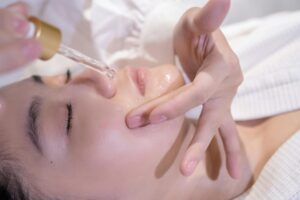
Start with a vitamin C serum if your facial is performed in the morning, or a niacinamide serum if performed in the evening. For evening facials, SkinCeuticals C E Ferulic ($182 for 30ml) is the gold standard for daytime use, but for evening, switch to a niacinamide formulation. The Ordinary Niacinamide 10% + Zinc 1% ($6.50 for 30ml) is a high-concentration option that regulates sebum and refines pores without irritation. Apply three drops to the palm, press the palms together, and pat the serum into the skin—do not rub. Rubbing disperses the product unevenly and reduces efficacy. Wait two minutes. The skin should feel slightly tacky, not wet. If it feels wet, you have used too much product. The ideal amount for a serum is three to four drops for the entire face and neck.
Next, apply a targeted treatment serum. This is where you address your primary concern: fine lines, hyperpigmentation, or loss of firmness. SkinCeuticals Retinol 0.3% ($68 for 30ml) is a well-tolerated retinoid that accelerates cell turnover without the irritation of higher concentrations. Apply one pump to the face and neck, avoiding the eye area and the corners of the mouth. Wait three minutes. If you are using a retinol, do not use a vitamin C serum in the same session—they can destabilise each other. Instead, use niacinamide followed by retinol, then a peptide serum for firmness. PCA Skin ExLinea Peptide Serum ($112 for 30ml) uses a blend of hexapeptides and acetyl octapeptide to relax expression lines while supporting collagen synthesis. Apply two drops and press in gently. The skin should now feel layered, not overloaded. If any product pills or balls up, you have either not waited long enough between layers or used too much of one product. In a professional facial, estheticians wait two to three minutes between each step. You should too.
Step Five: The Seal — Moisture, Occlusion, and the Final Caress
The final step of a professional facial is not a moisturiser in the conventional sense. It is a seal—a rich, occlusive layer that locks in all the serums and prevents transepidermal water loss overnight. This is where texture matters most. A lightweight lotion will not suffice. You need a cream or balm that contains occlusives like shea butter, squalane, or petrolatum, combined with humectants like glycerin or hyaluronic acid to continue drawing moisture into the skin throughout the night. The goal is to wake up
Related from our network
- How to Perform a Simple Ritual for Self-Love and Confidence (witchcraftforbeginners)
- The Magic of Self-Love: How to Create Rituals That Nourish You (witchcraftforbeginners)
- How to Make Your Rituals More Powerful Without Extra Tools (witchcraftforbeginners)
You Might Also Like


Reclaim Your Inner Seasons
Cycle wisdom, sacred rituals, and phase-aligned self-care — rooted in tradition, delivered to your inbox.
No spam. Unsubscribe anytime.
