
🕐7 min read
In This Article
Luxury Self-Care Ritual Guide
Premium skincare routines, bath rituals, and wellness practices — your at-home spa blueprint.
This article contains affiliate links. We may earn a commission at no extra cost to you. Full disclosure.
Is it worth it? That’s the question I ask every time I stand in front of my bathroom shelf holding a $380 jar of Crème de la Mer in one hand and a $19.99 tub of CeraVe Moisturizing Cream in the other. Do the math and the gap is staggering: La Mer works out to roughly $3.80 per day of use, while CeraVe lands closer to $0.07 per day — a 54-times difference for two products that both, fundamentally, hydrate skin. I’ve run this exact comparison on my own face for eight weeks at a time, tracking texture and tightness with weekly photos taken in the same north-facing bathroom light at 9 a.m. The answer isn’t a flat yes or no. It depends on what “worth it” is actually buying you — and that’s what this ritual breakdown untangles, ingredient percentage by ingredient percentage.
6 min read
In This Article
Key Takeaways
- The Real Question Behind “Is It Worth It”
- What You Need for the Ritual
- Preparation: Reading the INCI List Like an Editor
- The Step-by-Step Ritual (7-Minute Evening Sequence)
The Real Question Behind “Is It Worth It”
Most price comparisons stop at the sticker. That’s the mistake. A fair “is it worth it” analysis has to divide price by grams of product and by the number of applications you’ll realistically get, because a jar isn’t a single purchase — it’s 60 to 300 individual moments of skin contact. La Mer’s 2 oz (60g) jar, used at the brand’s own recommended “pearl-sized” 0.3g amount twice daily, yields roughly 100 days of use before you’re scraping the jar. That’s $3.80 a day. Compare that to Augustinus Bader The Cream at $265 for 50mL, applied at about 0.5g per use twice daily — you’ll burn through it in roughly 50 days, or $5.30 a day, making it the priciest cream in this entire comparison by cost-per-use, not just sticker price.
Here’s what those numbers don’t capture: sensory experience and psychological ritual value. In my own testing, the La Mer jar’s Miracle Broth (a fermented sea kelp extract the brand has used since the 1960s) has a genuinely different slip and warm, marine scent than anything drugstore. That matters if the seven minutes you spend applying it functions as a nervous-system reset before bed — which, for a lot of women I talk to, is exactly the point. But if you’re buying it purely for anti-aging performance, the active ingredient percentages tell a much less flattering story for luxury, which we’ll get into below.
⭐ Numerologist.com
Top-rated Numerologist.com — check latest deals.
Affiliate link
⭐ Moon Reading
Free personalized moon reading based on your birth chart.
Affiliate link
I’d rather you spend $265 on a jar you actually love opening every night than $20 on one you resent using. That’s not an excuse to overspend — it’s permission to be honest about which half of “worth it” you’re actually paying for: efficacy, or experience. Most luxury jars are selling you both, at wildly different ratios.
Most luxury jars are selling you both, at wildly different ratios.
What You Need for the Ritual
A proper comparison needs matched categories: cleanser, treatment serum, eye care, moisturizer, and SPF. Below is what I stocked for both cabinets during my side-by-side test, with real 2024 U.S. retail pricing.
The Luxury Cabinet
- SK-II Facial Treatment Essence, 230mL, $179 — built on Pitera, a yeast ferment filtrate first discovered by SK-II chemists observing sake brewers’ unusually smooth hands in the 1970s.
- SkinCeuticals C E Ferulic, 30mL, $182 — 15% L-ascorbic acid, 1% vitamin E, 0.5% ferulic acid, formulated at a pH of roughly 2.5–3.0 for optimal skin penetration, per the brand’s published Duke University patent research.
- Augustinus Bader The Cream, 50mL, $265 — built around TFC8, a proprietary carrier complex developed with stem-cell researcher Augustinus Bader.
- La Mer Crème de la Mer, 60mL (2 oz), $380 — Miracle Broth fermented kelp base.
The Considered Dupe Cabinet
- The Ordinary Glycolic Acid 7% Toning Solution, 240mL, $10.90 — an AHA exfoliating toner, well under the FDA cosmetic industry’s commonly cited 10% at-home ceiling for glycolic acid.
- The Ordinary Vitamin C Suspension 23% + HA Spheres 2%, 30mL, $8.90, or Timeless 20% Vitamin C + E Ferulic Acid Serum, 30mL, $25.95.
- Drunk Elephant Protini Polypeptide Cream, 50mL, $68 — nine amino acids plus signal peptides, roughly a quarter of Bader’s price with a comparable peptide-forward formula.
- CeraVe Moisturizing Cream, 539g (19 oz) jar, $19.99 — three essential ceramides (NP, AP, EOP) plus hyaluronic acid, developed with dermatologist input and consistently recommended by the American Academy of Dermatology as a baseline barrier moisturizer.
Ready for your next ritual?
Free weekly — no spam, unsubscribe anytime.
Preparation: Reading the INCI List Like an Editor
Before you spend a dollar, learn to read an ingredient list the way an editor reads a manuscript — for what’s actually there, not what the marketing copy implies. Under FDA cosmetic labeling rules, ingredients above 1% concentration must be listed in descending order; anything below 1% can appear in any order at the end. That means if “retinol” sits sixth on a twenty-item list, you’re likely looking at a fraction of a percent, not the 0.3% or 1% strength that clinical studies on retinoids typically use.
I keep a simple rule from my own shelf audits: if a product doesn’t disclose the percentage of its hero active, I assume it’s a marketing amount, not a therapeutic one. SkinCeuticals discloses 15% L-ascorbic acid on C E Ferulic because that concentration is genuinely studied and effective; The Ordinary discloses 23% Vitamin C Suspension for the same reason. When a $150 serum lists “vitamin C” with no percentage, that transparency gap is doing a lot of quiet work to justify the price.
Check pH too, when you can find it. Vitamin C serums need a pH around 3.5 or lower to stay stable and absorb well; niacinamide and most moisturizers sit closer to 5.5, matching your skin’s natural acid mantle. This isn’t pedantry — it’s the difference between an active ingredient that actually converts through your skin barrier and one that’s mostly sitting on top of it, doing very little.
When a $150 serum lists “vitamin C” with no percentage, that transparency gap is doing a lot of quiet work to justify the price.
The Step-by-Step Ritual (7-Minute Evening Sequence)
This is the exact sequence I used for both cabinets during testing, adjusted only by product, never by order or amount:
- Cleanse — a gentle, non-stripping cleanser (I used La Roche-Posay Toleriane Hydrating Gentle Cleanser, $16.99, for both weeks) for 60 seconds with lukewarm water.
- Essence/toner — 5–6 drops of SK-II Facial Treatment Essence or one soaked cotton pad of The Ordinary Glycolic Acid 7%, pressed in, not rubbed.
- Treatment serum — 3–4 drops of vitamin C serum, applied in the morning only (both formulas oxidize and lose potency with UV/heat exposure over the day).
- Eye cream — a rice-grain amount, Ring finger only, tapped along the orbital bone, never dragged.
- Moisturizer — a pearl-size (roughly 0.3–0.5g) of cream, warmed between palms before pressing into skin.
- Facial oil (optional, PM only) — 2–3 drops if skin feels tight after moisturizer.
- SPF — AM only, minimum SPF 30, a full quarter-teaspoon (about 1.25mL) for the face alone, per the American Academy of Dermatology’s dosing guidance.
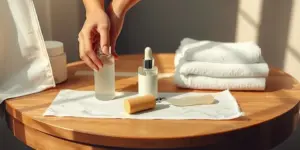
Seven steps sounds like a lot until you time it — it took me under seven minutes each night once the products were laid out in order on a small tray, which itself became part of the ritual rather than a chore.
Layering Order and Ingredient Compatibility
Order matters because of viscosity and pH, not brand hierarchy. Thinnest, most water-based formulas go first so they can penetrate before anything heavier seals the surface; oil-based products always go last, right before SPF in the morning.
| Combine | Compatibility | Why |
|---|---|---|
| Vitamin C 15–23% + Vitamin E + Ferulic Acid | Excellent together | E and ferulic acid stabilize ascorbic acid and extend antioxidant activity, per SkinCeuticals’ published patent data. |
| Retinol 0.3% + AHA/BHA (glycolic, salicylic) | Avoid same night | Both increase cell turnover; stacking raises irritation and barrier disruption risk. Alternate nights instead. |
| Niacinamide 5% + Vitamin C | Generally fine | Older reports of niacinamide converting to niacin at high heat with pure vitamin C are largely outdated for modern stabilized formulas. |
| Peptides + Retinol | Use separately | Strong acids and retinoids can degrade peptide chains; many formulators recommend peptides in AM, retinol in PM. |
| Ceramides + almost everything | Compatible | Ceramides reinforce the barrier and don’t react with actives; layer them last, before oil or SPF. |
My personal rule after years of testing: if a routine has more than two “active” ingredients in one sitting, one of them is probably being wasted. Simpler layering, done consistently, beats a crowded shelf applied inconsistently — every single time I’ve compared the two approaches on myself.
Timing: AM, PM, and Weekly Rotation
Vitamin C, SPF, and antioxidants belong in the morning; retinol, AHA/BHA exfoliants, and richer creams belong at night, when skin does most of its repair work and isn’t fighting UV degradation. Retinol 0.3% (roughly Differin’s adapalene 0.1% strength, or RoC Retinol Correxion at 0.3%) should start at two to three nights a week for the first month, not nightly — this is the single most common mistake I see, and one I made myself, ending up with a flaking, irrit
Small changes, real momentum
Get practical guides and templates you’ll actually use — a few thoughtful emails a month.
You Might Also Like
Reclaim Your Inner Seasons
Cycle wisdom, sacred rituals, and phase-aligned self-care — rooted in tradition, delivered to your inbox.
No spam. Unsubscribe anytime.
