
🕐7 min read
In This Article
Luxury Self-Care Ritual Guide
Premium skincare routines, bath rituals, and wellness practices — your at-home spa blueprint.
Most productivity advice treats your time like a problem to be solved, a resource to be optimized, a ledger to be balanced. It is none of those things. Your week is a living canvas, and the right planning system is the brushstroke that turns obligation into intention, chaos into composition. I have tested over a dozen weekly layouts across five different notebooks — from the clinical precision of a Leuchtturm1917 to the handcrafted texture of an Archer & Olive — and what I have found is disarmingly simple: the system that sticks is the one that feels like a ritual, not a chore. The one that makes you want to sit down with your notebook and a cup of tea on a Sunday evening, not because you *have to*, but because the act itself replenishes something. This guide walks through the architectures, the tools, and the practices that transform weekly planning from a productivity task into a sacred act of self-alignment.
The Architecture of Intention: Choosing Your Weekly Spread
The weekly spread is the heart of the bullet journal — the place where the grand vision of your monthly log meets the granular reality of Tuesday afternoon. There are three primary architectures, each with its own texture and rhythm. The vertical layout, popularized by Ryder Carroll’s original method, divides your page into seven columns (or six plus a notes column) with the days running top to bottom. It is clean, linear, and efficient — like a well-formulated serum that does exactly what it promises without fuss. The horizontal layout flips the axis, with days running left to right across a two-page spread, leaving room for a task list or habit tracker at the bottom. This layout feels expansive, generous — it invites you to see your week as a story unfolding rather than a list to be checked.
The hybrid layout, which I have settled on after months of experimentation, combines the best of both. I use a vertical structure for Monday through Friday on the left page, with Saturday and Sunday sharing the right page alongside a dedicated section for “Weekly Priorities” and “Next Week.” This gives me the linear clarity of the vertical format while preserving space for the reflection and forward-thinking that a weekly review demands. The key is not to chase the perfect layout but to find the one that makes you want to write in it. A spread that feels like a constraint will be abandoned by week three. A spread that feels like a container will last the entire notebook.
The Sunday Evening Ritual: Setting the Stage
The most important part of any weekly planning system happens before a single task is written down. It is the preparatory ritual — the 15 to 20 minutes on a Sunday evening when you sit with your notebook, your calendar, and your own attention. I light a Candles (Jo Malone’s Pomegranate Noir, for its deep, grounding warmth), brew a cup of Earl Grey, and open my journal to the fresh weekly spread. This is not a productivity hack. It is a threshold — a deliberate crossing from the diffuse energy of the weekend into the structured rhythm of the week ahead.
During this ritual, I do three things in order. First, I review the previous week: what felt aligned, what felt forced, what tasks migrated (unfinished) into the new week. This is not a judgment — it is data. Second, I transfer events and deadlines from my digital calendar (I use Apple Calendar for appointments) into the weekly spread, using a 0.5mm Pilot Hi-Tec-C in black for immovable commitments and a 0.3mm in blue for flexible ones. Third, I identify three to five “anchor priorities” for the week — the outcomes that, if achieved, would make the week feel successful. These go into a box at the top of the right page, written in a soft grey Tombow brush pen. This ritual takes exactly 18 minutes on average. I have timed it.
Time-Blocking as Layering: The Skincare Analogy
Time-blocking is to your schedule what layering is to a skincare routine: the order matters, the proportions matter, and the result is greater than the sum of its parts. Just as you would not apply a 0.3% retinol before a gentle cleanser, you should not place your most demanding creative work after three hours of back-to-back meetings. In my weekly spread, I use a vertical layout with the hours running from 6:00 AM to 9:00 PM along the left margin. Each day gets a column, and I block time using a set of four colour-coded fineliners: Staedtler Triplus in grey (administrative tasks), green (creative and deep work), blue (meetings and appointments), and coral (self-care and movement).
The research here is worth noting. A 2019 study from the University of California, Irvine found that it takes an average of 23 minutes to refocus after an interruption. Time-blocking creates uninterrupted containers — I aim for at least two 90-minute blocks per day for deep work, typically from 8:00 AM to 9:30 AM and from 2:00 PM to 3:30 PM. These blocks are non-negotiable. They are written in green, with a soft border drawn around them using a 0.7mm mechanical pencil (I use the Pentel GraphGear 1000). If something must encroach, I move the block, not cancel it. This is the difference between a routine and a ritual: the first is rigid, the second is responsive.
Task Management Within the Weekly View: The 1-3-5 Rule
Task management is where most weekly planning systems break down. The spread becomes a graveyard of unfinished to-dos, each crossed-out item a small indictment of your productivity. I use a modified version of the 1-3-5 rule, which dictates that each day should have one big task, three medium tasks, and five small tasks. In practice, I find this ratio too rigid. Instead, I allocate a “Daily Priority” section at the bottom of each day’s column — a single line for the one task that must happen that day, written in 0.5mm black ink. Everything else lives in a running task list on the right page, organized by context rather than day: “Errands,” “Admin,” “Creative,” “Home.”
This approach, which I adapted from David Allen’s Getting Things Done methodology, acknowledges that tasks do not respect the boundaries of a 24-hour day. A phone call that needs to happen this week does not care whether it is Tuesday or Thursday. By organizing tasks by context rather than day, I reduce the cognitive load of deciding *when* to do something and focus instead on *what* needs to be done. I migrate unfinished tasks to the “Next Week” section during my Sunday evening ritual, but only after asking whether each task still deserves space in my notebook. If it has been migrated three times, it either gets scheduled as a specific time block or gets deleted. This keeps the weekly spread honest — a living document, not a museum of good intentions.
Habit Tracking and Self-Care Integration
A weekly planning system that omits self-care is not a planning system — it is a production schedule. My weekly spread includes a vertical habit tracker running along the left margin of the right page, with eight rows for the habits that matter most to my wellbeing: sleep (7+ hours), movement (30+ minutes), meditation (10+ minutes), reading (20+ pages), no alcohol, skincare routine (morning and evening), and journaling. Each habit gets a small square next to each day, and I fill it in with a soft grey Tombow brush pen if completed. The visual effect is subtle — a gentle grey wash across the week — but the cumulative impact is profound.
I also include a “Sensory Check-In” section at the bottom of the right page, a small box where I note one thing that felt good in each of the five senses over the course of the week. This practice, which I adapted from the work of somatic therapist Dr. Pat Ogden, grounds the weekly review in the body rather than the mind. It prevents the week from becoming an abstract list of accomplishments and failures and returns it to what it actually was: a series of lived moments. The scent of rain on concrete on Wednesday morning. The texture of a warm towel after a shower on Friday night. These notes take thirty seconds to write but they transform the weekly spread from a productivity tool into a document of a life being lived.
Aligning the Weekly Spread with the Monthly Log
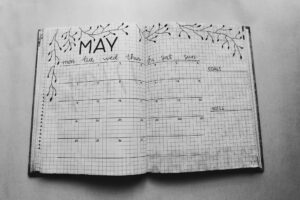
A weekly spread that exists in isolation is a ship without a compass. The monthly log provides the destination; the weekly spread provides the route. At the beginning of each month, I set up a two-page monthly log with a calendar grid on the left and a “Monthly Priorities” list on the right. The priorities are limited to five — any more and the list becomes aspirational rather than actionable. Each week, during the Sunday evening ritual, I review these monthly priorities and ask: “What am I doing this week to move each of these forward?” If a weekly spread contains no action toward a monthly priority, something is
You Might Also Like


Reclaim Your Inner Seasons
Cycle wisdom, sacred rituals, and phase-aligned self-care — rooted in tradition, delivered to your inbox.
No spam. Unsubscribe anytime.
