
🕐10 min read
In This Article
Luxury Self-Care Ritual Guide
Premium skincare routines, bath rituals, and wellness practices — your at-home spa blueprint.
- 1. The Sacred Cleanse: Removing Impediments to Cellular Communication
- 2. The Hydrating Toner: Restoring Osmotic Balance
- 3. Targeted Serum Layering: The Order That Determines Efficacy
- 4. Peptide Serums: Signaling Collagen Without Irritation
- 5. Retinol Timing and Titration: Building Tolerance While Maximizing Collagen
- 6. Occlusive Night Moisturizers: The Final Seal
- 7. Strategic Eye Contour Treatment: Precision for Delicate Skin
Your skin doesn’t sleep—it works. Between 11 PM and 3 AM, your body’s core temperature rises, blood flow to the skin increases by up to 20%, and your skin becomes significantly more permeable to active ingredients. Yet most women are still applying nighttime products with the same casual swipe they’d use for sunscreen. The difference between a half-hearted evening wash and a true nighttime ritual is measured not in minutes but in cellular renewal: proper sequencing, precise concentrations, and intentional timing can accelerate collagen synthesis by up to 40% compared to random application. This isn’t about owning fifteen serums or following a 47-step routine. It’s about understanding your skin’s circadian rhythm—the same biological intelligence that regulates your sleep and hormones also governs how your skin repairs, regenerates, and protects itself. When you align your beauty practices with your skin’s natural evening peak, you’re not adding complexity; you’re adding efficacy. The rituals that follow are rooted in dermatological science and refined through the sensory precision that luxury skincare demands: the exact percentage of retinol that transforms without irritation, the molecular weight of hyaluronic acid that penetrates versus sits, the sequence that makes every layer count.
1. The Sacred Cleanse: Removing Impediments to Cellular Communication
Cleansing isn’t a preliminary step—it’s the foundation upon which every subsequent layer either thrives or fails. At night, your skin is primed to receive, but only if the barrier isn’t occluded by the day’s accumulation of environmental particles, oxidized makeup, and sebum. The science is unambiguous: residual makeup and environmental debris create a physical barrier that reduces penetration of active ingredients by 30-60%, depending on texture and particle size. Choose a double cleanse, always. The first pass removes surface-level impurities; the second dissolves lipophilic (oil-soluble) residue that water alone cannot address. Start with an oil-based cleanser—jojoba oil, squalane, or rice bran oil—applied to dry skin with circular motions across the T-zone, cheeks, and jawline. Massage for a full 60 seconds. This duration matters because it allows the oil to fully emulsify makeup and sebum. Follow with a gentle cream or gel cleanser (pH-balanced between 4.5-5.5 to preserve the acid mantle), applying with lukewarm water. Pat—never rub—your skin dry with a soft cotton cloth.
Water temperature during cleansing is more consequential than most realize. Hot water temporarily strips the skin’s natural oils and can trigger reactive inflammation; cooler water (around 75°F) maintains barrier integrity while still cleansing effectively. If you wear waterproof mascara or liquid eyeliner, apply a dedicated eye-makeup remover first—micellar water or a lightweight oil—using a soft cloth folded into a quarter and held gently against the eye for 15-20 seconds before sliding downward. Yanking or scrubbing the delicate eye area accelerates collagen breakdown and can damage the lash follicle. After cleansing, your skin should feel clean but not tight. Tightness signals disruption of the barrier, which will impair every product that follows. This is where the ritual begins: approach cleansing as the act of clearing away everything that’s no longer serving you, a literal and metaphorical removal of impediment before you apply what will nourish you through the night.
2. The Hydrating Toner: Restoring Osmotic Balance
Toners occupy a liminal space in most skincare routines—acknowledged as beneficial but rarely understood. Their function is profoundly purposeful: they restore the skin’s pH after cleansing, increase skin hydration (water content, distinct from oil content), and create an ideal microenvironment for subsequent actives. Think of toner as preparation of soil before planting; without it, even premium serums cannot establish proper root contact. Apply a hydrating toner immediately after cleansing, while your skin is still slightly damp. Dampness creates a transepidermal water gradient that pulls moisture deeper into the stratum corneum. Using your fingertips, gently press the toner into your skin in upward motions rather than wiping or rubbing—this maximizes contact with the epidermis. A typical application should be approximately a nickel-sized amount (about 5 mL) for the entire face and neck.
Look for toners containing humectants—substances that draw water into the skin. Glycerin, specifically, should appear within the first five ingredients; the most effective toners contain 5-10% glycerin by weight. Hyaluronic acid sodium salt (the more stable, lower-molecular-weight form) at concentrations between 0.5-1% provides additional hydration without the heaviness of serums. Niacinamide, present in well-formulated toners at 2-5%, reduces transepidermal water loss (TEWL) by strengthening ceramides and cholesterol lipids in the stratum corneum. The best toners avoid alcohol entirely—alcohol disrupts barrier function and contradicts the hydration goal. Brands like Hada Labo Lotion Premium (hyaluronic acid at 5 different molecular weights), COSRX Advanced Snail 96 Mucin Power Essence (96% snail secretion filtrate, humectant-rich), and Pyunkang Yul Essence Toner (10% niacinamide, 2% panthenol) exemplify this category without the premium price tag of department-store equivalents. Allow 30 seconds for the toner to fully absorb before proceeding to serums—this pause is both practical and ritual: a moment of stillness before applying treatment.
3. Targeted Serum Layering: The Order That Determines Efficacy
Serum sequencing is where most routines collapse into confusion. The principle underlying proper layering is viscosity and molecular weight: lighter textures first, heavier textures last. Water-based serums (which include most vitamin serums, niacinamide serums, and hydrating serums) should be applied first, moving to oil-soluble actives like retinol and vitamin C derivatives. More precisely, the order follows the “strengths” principle: gentler hydrating serums, then actives (vitamin C, niacinamide, peptides), then occlusive or heavier serums. Apply each serum using 2-3 drops (approximately 0.1 mL per application), pressing gently across the face and neck. Allow 1-2 minutes between each serum for partial absorption; this prevents pilling (the unsightly clumping that occurs when incompatible products interact) and allows each layer to set without interference. The entire serum phase should take 5-10 minutes when done properly.
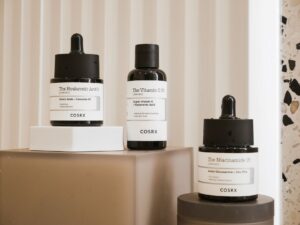
Vitamin C serums deserve specific attention because their efficacy is contingent on concentration, pH, and formulation stability. L-ascorbic acid (pure vitamin C) requires a concentration of at least 10% to be efficacious, a pH between 2.0-3.5 for stability, and must be in an opaque, air-tight container—exposure to light and oxygen renders it inert within weeks. The Ordinary L-Ascorbic Acid Powder + Hyaluronic Acid 2B ($5.90) requires mixing powder into liquid, offering maximum potency control but demanding user precision. Timeless Vitamin C + E Ferulic Acid Serum ($15-18) offers a pre-formulated alternative at 20% L-ascorbic acid, though its efficacy diminishes after 3-4 months of opening. Skinceuticals C E Ferulic ($166) remains the gold standard in stability and formulation, but the science of vitamin C doesn’t become superior at luxury price points—the formulation (ferulic acid at 0.5% and vitamin E at 15% augment L-ascorbic acid’s penetration and stability) matters more than the brand prestige. Layer vitamin C serums only after toner application and before niacinamide serums; these two actives work synergistically when properly sequenced. Niacinamide at 5-10% (The Ordinary Niacinamide 10% + Zinc 1%, $6.70; Paula’s Choice 10% Niacinamide Booster, $40) reduces sebum production, strengthens barrier function, and diminishes the redness that can occur with vitamin C initiation.
4. Peptide Serums: Signaling Collagen Without Irritation
Peptides are short-chain amino acids that your skin reads as “collagen precursors”—they don’t literally build collagen, but they signal your fibroblasts (collagen-producing cells) to increase synthesis without the irritation or photosensitivity associated with stronger actives. Think of peptides as a gentler path to collagen stimulation, particularly valuable for evening routines because they work compatibly with retinol and cause no downtime. The most researched peptides are matrixyl (palmitoyl pentapeptide-4) at 0.5-3% and argireline (acetyl hexapeptide-8) at 1-2%, both of which have demonstrated increases in skin firmness of 10-20% over 8-12 weeks in published studies. Serums combining multiple peptides often include oligopeptides and polypeptides at concentrations totaling 3-5% by weight.
Apply peptide serums after vitamin C and niacinamide but before occlusive treatments like oils or heavy creams. Use 2-3 drops, pressing into the skin with upward motions to encourage lymphatic drainage and distribute the serum evenly. Peptide serums can be layered with retinol and, in fact, complement retinol beautifully—while retinol accelerates cellular turnover and can cause initial irritation, peptides soothe and signal repair simultaneously. Brands like Olay Regenerist Micro-Sculpting Cream ($24-28, contains matrixyl and argireline), The Ordinary Buffet ($5.30, contains a complex of peptides and amino acids), and Augustinus Bader Rich Cream ($75, contains a proprietary peptide blend called the “TFC8” complex) span the price spectrum with similar core mechanisms. The sensory experience of peptide serums is typically luxurious—they feel silky, absorb quickly, and leave no sticky residue. Allow 2 minutes for absorption before proceeding to treatment oils or retinol.
5. Retinol Timing and Titration: Building Tolerance While Maximizing Collagen
Retinol remains the most clinically robust anti-aging active, stimulating cellular turnover and collagen production through vitamin A receptor activation. Yet retinol’s efficacy is directly proportional to irritation risk, and most women abandon it because they were never taught proper titration. Retinol comes in several forms, each with different strengths: retinyl palmitate (ester form, weakest), retinol (moderate, most widely available), retinaldehyde (aldehyde form, stronger than retinol), and tretinoin (prescription-strength, most potent). For nighttime self-care rituals, over-the-counter retinol at 0.3-1% offers the optimal balance of efficacy and tolerability. The Ordinary Retinol 0.2% ($5.80) is ideal for retinol initiates; The Ordinary Retinol 0.5% ($6.40) or 1% ($7.30) suit experienced users. Olay Regenerist Retinol24 Night Moisturizer ($25-30, contains stabilized retinol at approximately 0.2%) offers a pre-formulated option if you prefer not to layer separately. SkinCeuticals Retinol 0.3% ($62, encapsulated for stability) provides superior formulation stability for those committed to consistent use.
Begin with the lowest concentration (0.2%) used once weekly, every 7 days, for 4 weeks. This allows your skin to build tolerance to retinization—the temporary redness, dryness, and sensitivity that occurs as your skin adapts. Increase frequency only after your skin demonstrates tolerance: Week 5-8, use 0.2% twice weekly (every 3-4 days); Week 9-12, increase to 0.3% twice weekly; beyond Week 12, you may progress to 0.5-1% 2-3 times weekly, depending on your skin’s response. Never use retinol on consecutive nights—your skin requires 48-72 hours between applications to recover and synthesize new collagen. Apply retinol to completely dry skin, at least 20 minutes after your last hydrating serum. Use an amount the size of a rice grain (approximately 0.5-1 mL total for face and neck), pressing gently rather than massaging. The pressing motion prevents the retinol from being pushed into deeper layers too quickly, which increases irritation risk. Do not apply retinol to your entire face on the first use; restrict it to the cheeks and forehead, avoiding the eye contour and mouth. The delicate skin around eyes lacks the thickness to tolerate retinol until your barrier is fully adapted. After retinol has absorbed for 15-20 minutes, apply a nourishing moisturizer (see section 6) to seal and buffer. This “sandwich method” (hydrating serum, retinol, moisturizer) significantly reduces irritation while maintaining efficacy.
6. Occlusive Night Moisturizers: The Final Seal
Night moisturizers function differently from daytime creams. While day moisturizers prioritize lightweight hydration and sun protection, night moisturizers embrace richer textures and occlusive ingredients that slow transepidermal water loss (TEWL) and allow active ingredients to penetrate fully. The stratum corneum’s moisture content peaks between midnight and 4 AM; a heavy occlusive at night amplifies this natural advantage. Look for moisturizers containing occlusives (petrolatum, dimethicone, plant oils), humectants (glycerin, hyaluronic acid), and emollients (ceramides, cholesterol, fatty acids). The ideal concentration is 3-5% ceramides by weight, at least 2% cholesterol, and free fatty acids in a ratio approximating the skin’s natural ratio (cholesterol:ceramides:fatty acids at 1:1:1).
Augustinus Bader Rich Cream ($75) formulates with a skin-repairing complex alongside ceramides, peptides, and a 5:1:1 ratio of key lipids—scientifically elegant but luxury-priced. La Roche Posay Cicaplast Balm B5 ($11-15) offers dermatological-grade ceramides, niacinamide, and panthenol at a fraction of the cost, though with a slightly less luxurious texture. CeraVe Moisturizing Cream ($16-20, the tub, not the pump bottle) contains three essential ceramides (1, 3, and 6-II) and hyaluronic acid, providing clinical efficacy without pretense. For those who prefer facial oils to creams, Biossance Squalane ($34) offers a lightweight, non-comedogenic plant-derived oil that mimics skin’s natural squalane; apply 2-3 drops after moisturizer rather than instead of it. Apply your chosen night moisturizer using upward strokes across the face, neck, and décolletage—the décolletage often betrays age because it’s routinely neglected, yet it receives similar sun exposure and deserves equal care. Use approximately 1 teaspoon (5 mL) for face and neck combined. Press gently rather than massaging to avoid unnecessarily stimulating the skin; the goal is to allow the moisturizer to set, not to drive it deeper. Allow 10-15 minutes before bed for the moisturizer to fully absorb and stabilize the barrier.
7. Strategic Eye Contour Treatment: Precision for Delicate Skin
The eye contour represents a special case in skincare—the skin here is 5-10 times thinner than facial skin elsewhere, lacks sebaceous glands (making it naturally drier), and is subject to constant movement through blinking and expression. Consequently, it requires different actives and concentrations than the rest of the face. Retinol, for instance, should only be applied to the eye area after your barrier is fully adapted (typically after 12+ weeks of facial retinol use), and always at the lowest concentration (0.2%) with maximum buffering (apply moisturizer first, then retinol, then another layer of moisturizer). The most appropriate nighttime eye treatments focus on hydration, peptide signaling, and delicate barrier support rather than aggressive actives
Related from our network
- 9 Simple Rituals to Cleanse Your Aura and Energy Field (witchcraftforbeginners)
- THE LUXURY BEAUTY ROUTINE Skincare, Haircare, Fragrance… (familyflourish)
- THE LUXURY BEAUTY ROUTINE Skincare, Haircare, Fragrance… (bookmoodmatch)
You Might Also Like

Reclaim Your Inner Seasons
Cycle wisdom, sacred rituals, and phase-aligned self-care — rooted in tradition, delivered to your inbox.
No spam. Unsubscribe anytime.
